I stored my Chicago Hardy fig at my parents' farm over the winter in a part of a barn that they keep heated. I got this tree as a root ball from T&T seeds in the spring of 2015. After an intial struggle it took off and grow to about 15" tall by the fall. After all the leaves had fallen off and after it had experience a few frosts I took it indoors before it got really cold (although this winter there hasn't been a whole lot of that).
The room that it was stored in stayed a little above zero for the last few months. About three weeks ago I brought it home and just kept it inside. It took about a week and a half for the buds to start developing and it has been growing very rapidly since. Last year my wife bought me an X-Up Flowerhouse Pro Greenhouse from Early's in Saskatoon. Because of the large amount of space that this now gives me I decided to give the fig a bit of a head-start on the year in the hopes that it will guarantee me at least one ripe fig by fall. Considering that I have yet to taste a fresh ripe fig I figured this would be useful before I get too excited over them. Regardless of whether I get fruit this year I do love the look of the foliage on figs. They have a very tropical look to them (at least to this boreal dweller!).
I've been perusing the website figs4fun and figsforlife and they've both been providing me with some excellent information on what to expect in terms of pruning, how the figs develop and variety information. Figsforlife is a Canadian site and their rates look very reasonable and they also ship across Canada. If I hadn't already bought so many fruit trees this year I would definitely be making some purchases there. Oh well, there's always next year.
Monday, 7 March 2016
Tuesday, 1 December 2015
Shade Mapping
Shade Mapping
I recently used Sketchup to model the distribution of shade in my front yard. In the coming summer I plan to convert it to a garden and would like some guidance on where to plant different varieties. Because the front yard is north of the house part of it is covered in deep shade even during the middle of summer. As well because I live at such a high latitude (52 degrees north) the house casts quite long shadows. Sketchup's geolocation function allows you to use Google Maps satellite data to locate models in the real world. Once Sketchup knows the latitude of the model it can accurately model the shadows cast throughout the year off of any given model. I'm not aware of an easy way of getting Sketchup to track shade, so instead I modeled in hour by hour by drawing shapes to match the shade then added up the hours that each shape spent in the shade. I then applied a colors to the shapes to indicate the length of time spent in shade.
In the map you are looking South-West (the house is orientated almost directly North-South). The area running from the street South along the East side of the house is the drive way. During the summer I put a number of planters and containers for growing vegetables in the driveway. I had intended on placing planter boxes along the house on the driveway, however this map has made me realize how much shade this area actually gets. I will likely try to put most containers along the North-East edge of the driveway to maximize the amount of sunlight they get.
It's a really nice feature of Sketchup and nice to use in planning of new gardens.
Tuesday, 14 July 2015
Russian olives, olives, and wild dreams
![]() |
| Foliage of the Russian Olive |
![]() |
| Russian olive tree from my local nursery |
| Russian olive environmental suitability according to research by Lianna Collette |
![]() |
| Arbequina olives |
Sunday, 5 July 2015
Strawberries & Figs
I started a quick little project today. I took some June-bearing strawberries from my parents' farm and put them in some planters. Hopefully they will transplant without too much shock. There was a grand total of 2 strawberries already growing on them, so I'm hoping their most productive days are still ahead. June-bearing strawberries only yield a single batch of fruit and then stop producing for the remainder of the summer. As an alternative there are also ever-bearing strawberries. These produce a small trickle of fruit all summer long. I have heard a lot of complaints about the productivity of this type, so although I would like strawberries all summer long I'll stick with the free ones I've got.
The U of S's recommendation variety when it comes to June-bearing strawberries this year is Cavendish. At their plant sale this spring I bought a few Kent to plant at the farm. This blog seems to have quite a good experience with them, and from the sounds of it Cavendish has quite a long productive season so that may be a purchase for next spring.
In other news my Chicago Fig from T & T seeds continues to finally sprout. The root bundle had a very tenous sprout when I recieved it in the mail, however it quickly broke off when I unpackaged it. I had given up all hope when last week it finally sprang into life again. I had first seen figs last year on sale at Super Value (President's Choice), but I had dismissed it as yet another item that was on sale in Saskatchewan, but couldn't survive outside a small area in Niagara or Vancouver. But it turns out with a little winter love and care they can be grown here. More on that in a few months I guess!
Friday, 3 July 2015
Grape variety update
It's been a while since I posted so I'l try to update a few things.

This is the south facing side of my garage in the back alley. Unfortunately I don't have any "before" pictures, but before I started this project it was just weeds back here. This is now the second summer of the project and it's progressing very nicely. There are currently four grapes planted in the ground as well as two grapes in pots. The garden planter boxes are also new to this year. They are planted with zucchini on either end (one yellow and one green). There are also cucumbers, eggplant, dill, green onions, basil,rosemary, parsley, borage and a ton of beets packed in there.

Going from left to right in the picture above, the grapes are Marechel Foch, Severnji, Frontenac, F130, Marechel Foch, and Fredonia. I had previously written about Severji, which is an interspecific hybrid of european and amurensis grapes. It was very delayed in budding out this spring and so I took it for dead. Everything I had read stated that the amurensis genes would cause early bud break, but it did not occur for me, or at least not this year. Because I thought it was dead I dug it up, but put it in a pot to hedge my bets. In either case it died back to very close to its base and so it hasn't set any fruit this year, not that I expected much.
![]() |
| F-130 grape from Boughen Nurseries |
The F130 and Fredonia grapes were new this year. I bought them from Boughen Nurseries in Manitoba. I haven't been able to find any information on the background of F-130, which normally would bug me so much I wouldn't even be willing to try it! They budded out pretty slowly, and I definitely wouldn't call their growth thus far vigorous, but it's early.
![]() |
| Fredonia grape from Boughen Nurseries |
Fredonia from what I understand, is also called "Early Concord". It is the result of a cross of labrusca and riparia grapes, and in theory has some of the same taste as concord grapes.
The only information I have been able to find on F-130 is that it has "good flavour" and "produces larger clusters than beta or valiant". Based on that I'm hopeful!
![]() |
| Marechel Foch grape growing in a 10 gallon pot |
This spring I also bought two Foch grapes from the local Home Depot. It was both exciting and frustrating to see. It was exciting for me to see this variety available locally as it saved me the difficulty of hunting it down online, however I also knew that most people would not know what they were going to be getting into, and a lot of plants were going to die!
Foch is a French hybrid grape which is the result of a cross between a European grape (Goldriesling) and a rupestris-riparia hybrid. In theory it is hardy down to at least -32C, however I don't see it being close to hardy enough to survive outdoors in Saskatchewan, at least not most winters. Because of my doubts I have planted one Foch in the ground and will keep the other in a pot which will over-winter in a room that's kept at about 5C. The plant in the container is doing significantly better than the buried vine, however the plants also appeared to be infected with some sort of virus when I bought them, so it may be a difference of infection levels more than anything.
Sunday, 17 August 2014
Vitis "severnyi" inter-specific grape
![]() |
| V. amurensis at the Patterson Arboretum |
![]() |
| V. "Frontenac" containing no amurensis genetics, no leaf indent |
- Severnyi's parents are a Vitis amurensis and Seyanets Malingre (which itself is the open pollinated product of Malingre Precose, a French white vinifera grape).
- Severnyi is also commonly called Severnji, this appears to be an artifact of translation
- Requires cross pollination
- Severnyi has been used as an intermediete in Russian and other's grape breeding, producing two more renowned varieties, Saperavi Severnyi, and Cabernet Severnyi
![]() |
| V. "Severnyi" showing the deep leaf indents due to its amurensis genetics |
Cabernet Severnyi is one of the most popular varieties at a vineyard in Quebec called Carone who produce a wine called "Venice".
In term of hardiness the tag that it came with from Dutch Growers indicated Zone 3, one zone hardier than the most optimistic rating for Frontenac. I wish I had a list to provide of other carriers of this variety as well as any of its derivatives. Anyone with this information please let me know!
Monday, 11 August 2014
Actinidia continued
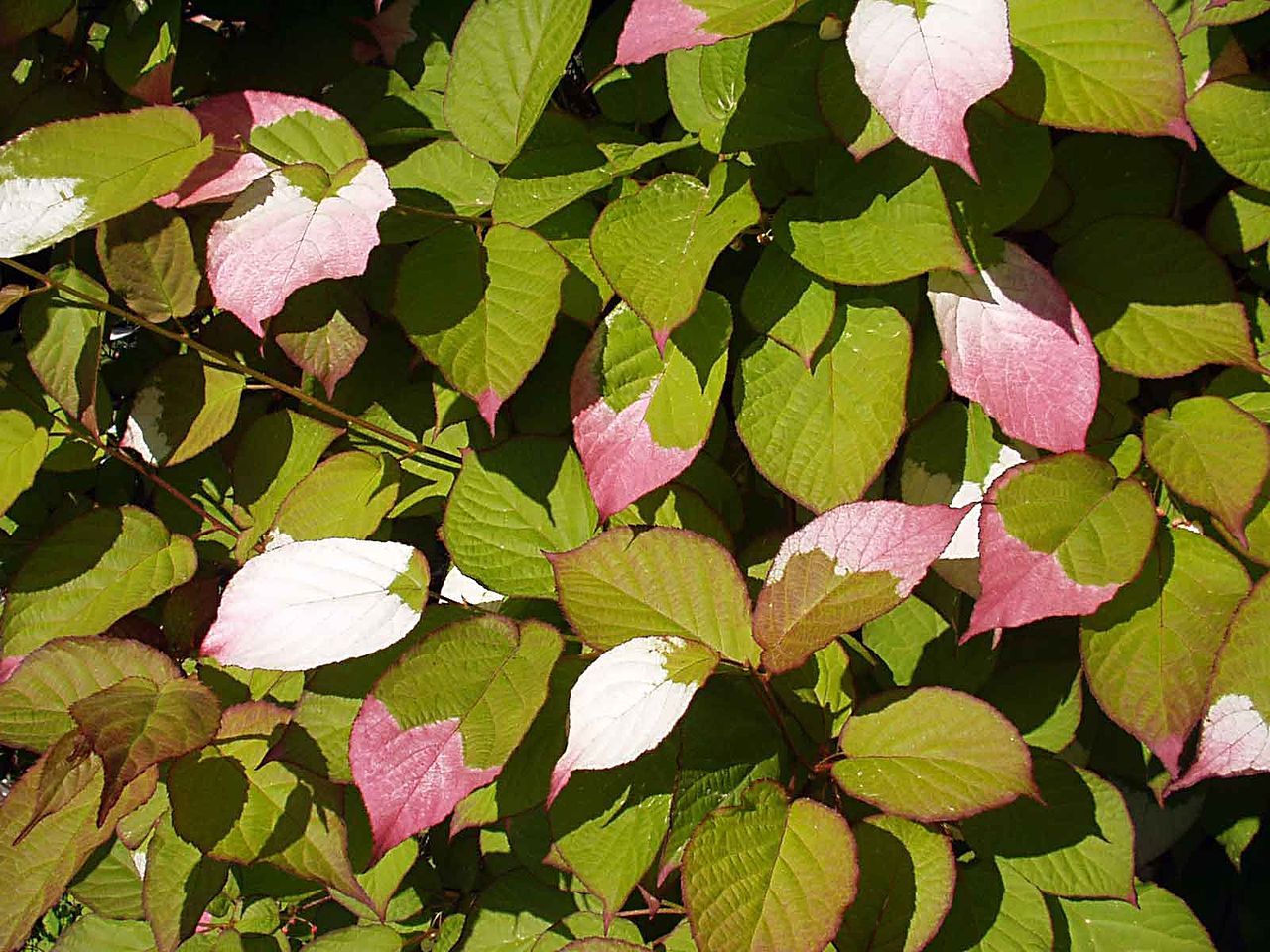
Dutch Growers lists a variety of kolomitka, "Arctic Beauty" as hardy to zone 3b. On a recent trip to Dutch Growers I did not notice this plant there and it may be something that they stock on certain years. Arctic Kiwi's do produce fruit, however they are the size of a pea and so growing them will likely be for more ornamental purposes than anything. Other websites I have seen do list Arctic Beauty as capable of producing "large grape sized" fruit which would fit what I have seen from my cutting's parent vine. Vesey's states that only certain vines produce both male and female flowers and in general yeilds will be improved with both male and female plants. In the end it is very possible that the cuttings I have are kolomitka.
Many varieties of arguta exist and so because I'm not sure of the origins of the cuttings that I have started I'm not sure which variety it is. One of the most popular variety of hardy kiwi is Issai. This variety does not require male and female plants and so reduces the amount of space you need to dedicate. Various catalogues have varying views on which zone this variety is hardy until. Dunvegan gardens in Edmonton lists Issai as hardy to Zone 4a. For more information I highly recommend this blog by a fellow named Dave who lives near Red Deer Alberta and grows Issai.The cuttings I have started do require both the male and female and so it is unlikely that they are Issai. Lake Shore greenhouse also in Saskatoon sells a Hardy Kiwi that is an unlisted variety. Their website states the plant is hardy to 4a. Varieties Anna (Ananasnaya), Meader, and Geneva also exist but are rated Zone 4 or warmer.
Subscribe to:
Posts (Atom)